
Ingredients

Equipment
Instructions
For the chiles
- Toast the poblano peppers on your comal or griddle. Let them sweat in a plastic bag to take off the skin. Before cleaning them, there are some people who will put on some oil in their hands, others prefer wearing latex gloves and clean the inside of the peppers -taking the seeds and veins out- without having the risk of having chilly fingers. Also, for those who do not like their poblanos very spicy, there are people who soak the peppers in salted water for a while to calm the spiciness as much as possible.
- Separately, heat a big enough pot with about 2 Tablespoons of the oil and sautée the finely chopped onion and garlic. Add the ground meat, the tomato previously roasted, peeled, and chopped, as well as the chicken stock. Let it cook at a medium heat until the meat is tender and there is no liquid left in the preparation. Add the spices, the fresh fruit chopped into small cubes, the dry raisins, candied pineapple, capers, chopped olives, and slivered almonds. Season with salt, pepper, a pinch of sugar (if needed), and a touch of sherry. Let the cooking liquid evaporate. Once the stuffing is ready, set aside and let it cool down.
For the nogada sauce
- Even though everyone recommends preparing the nogada one hour before serving to avoid oxidation, the walnuts must be cleaned, peeled and let to rest in milk since the night before. Consider that in order to peel the walnuts more easily, soaking them in hot water will help. Thus, before serving, put in the blender or food processor the peeled walnuts with the milk they were soaked in, the cheese, a pinch of sugar, cinnamon, and half a glass of dry sherry. Adjust the seasoning with a bit of heavy cream or milk if deemed necessary. The result must be a smooth sauce.
Plating
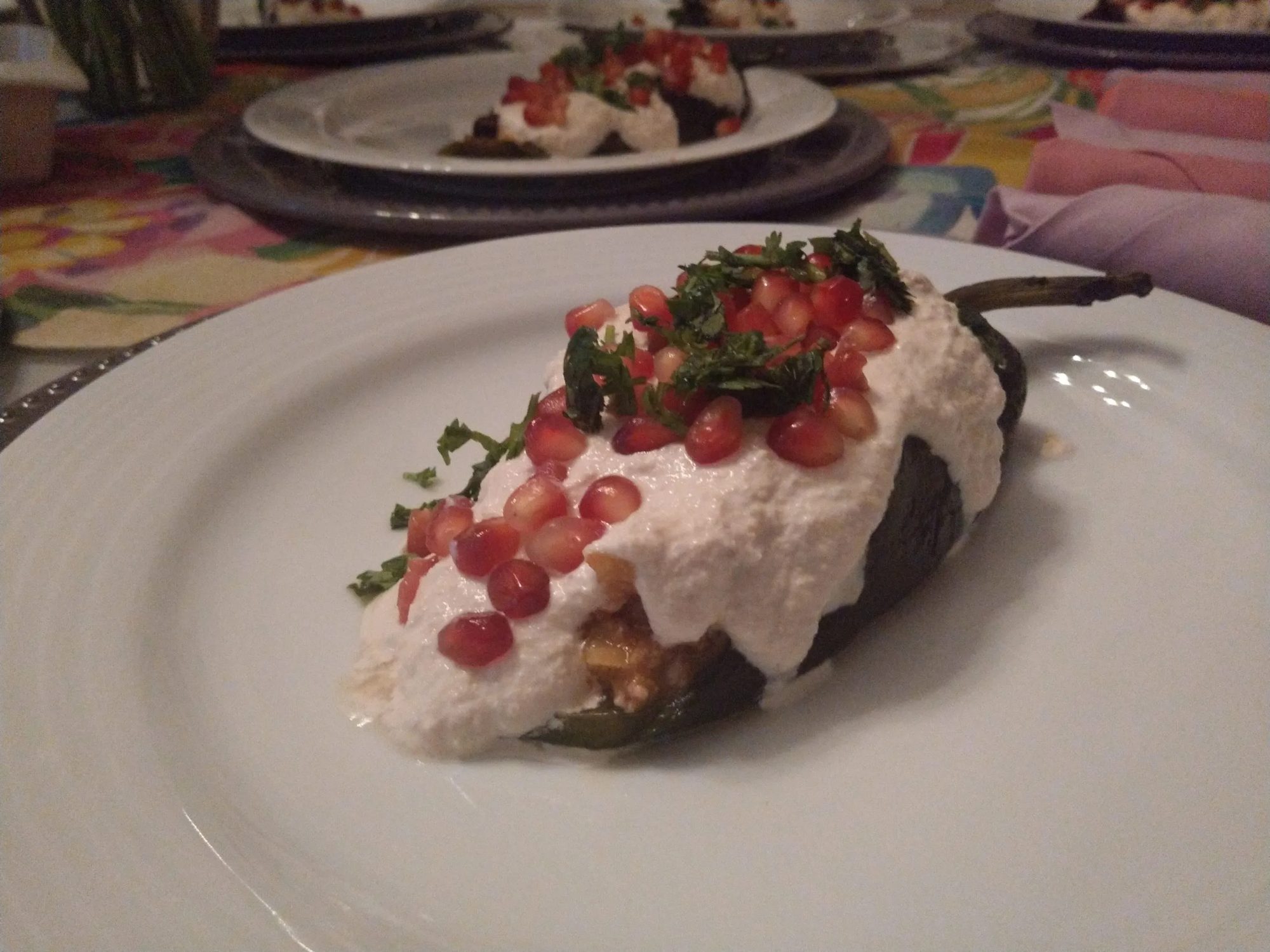
- Once the poblano peppers have been stuffed, they may be covered with the egg batter. To do so, beat the five egg whites to stiff peaks, and then incorporate the egg yolks. Cover the poblano peppers with flour, and then with the beaten airy eggs and fry in a skillet with hot oil. On the other hand, I prefer to have mine without the batter coating, but that is a license I allow myself to take, for the batter coating is a feature of the cuisine of the period when they were invented for a feast preparation as this one. Also, please consider that this is a plate that is served at room temperature and served with the nogada sauce on top, and decorated with the pomegranate seeds and a bit of parsley leaves coarsely chopped.
Notes
I wouldn’t doubt in just making half the recipe. It will be plenty. The calculus of the nutrition table is made for chiles WITHOUT the batter coating. Note that the original recipe calls for a type of apple called “panochera”, but finding it outside of Mexico is impossible. I substitute it with Fuji to obtain a similar flavor scheme. Also, the type of cheese suggested for the sauce is called “requesón”, which in texture and mild type of flavor would be similar to ricotta, therefore, this might be a substitution to work well with the Nogada sauce. Before 2016, this recipe was generally prepared with acitrón, a candied cactus. However, this is nowadays a species considered at risk of extinction. So, what I do, is I substitute with candied pineapple. It works really well.
* Post edited and updated on September 9, 2021.